
The Symbolism Behind Classic Japanese Tattoo Motifs
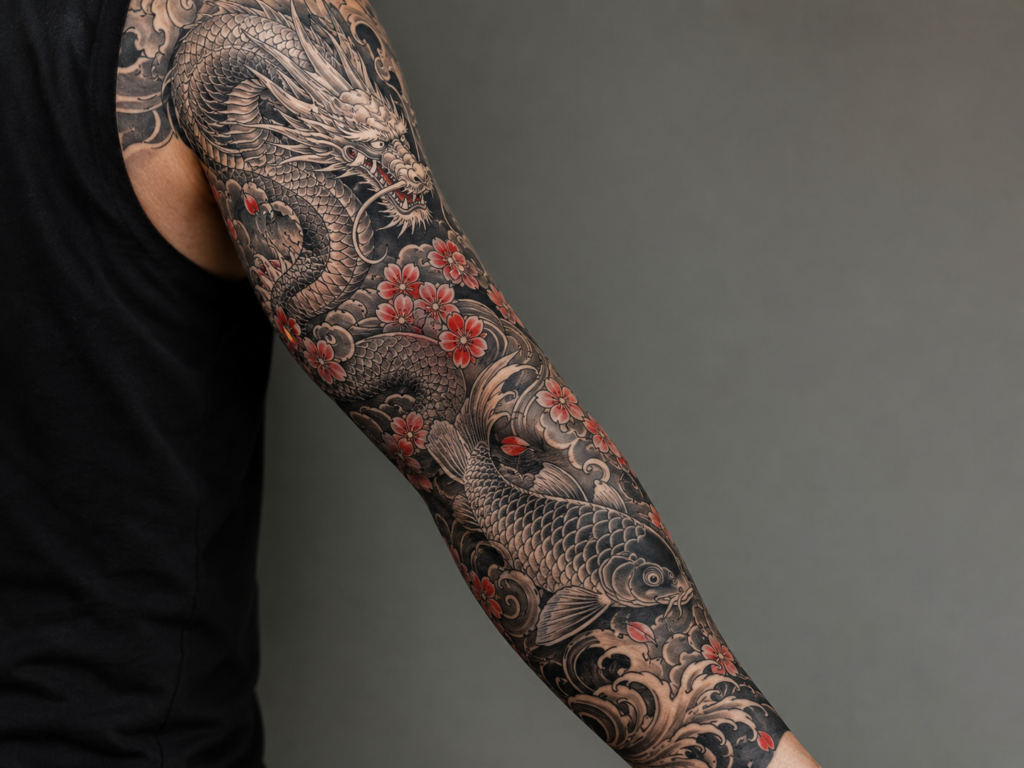
apanese tattooing, known as irezumi, is one of the most visually rich and symbolically dense tattoo traditions in the world. Unlike many Western tattoo styles that lean on individual images chosen purely for personal meaning, traditional Japanese tattoo art draws from a shared visual language — one built over centuries through woodblock prints, folklore, religious belief, and observation of the natural world. Every koi fish, dragon, or cherry blossom placed on the skin carries layers of meaning that go far beyond decoration, and understanding where these images come from changes the way the tattoos themselves are read.
This deep well of symbolism is part of what has made Japanese-style tattooing so influential worldwide. Artists and collectors far outside Japan borrow these motifs constantly, but often without knowing the stories behind them. Here’s a closer look at three of the most iconic images in the tradition — the koi, the dragon, and the cherry blossom — and what they actually represent.
The Koi: Perseverance and Transformation
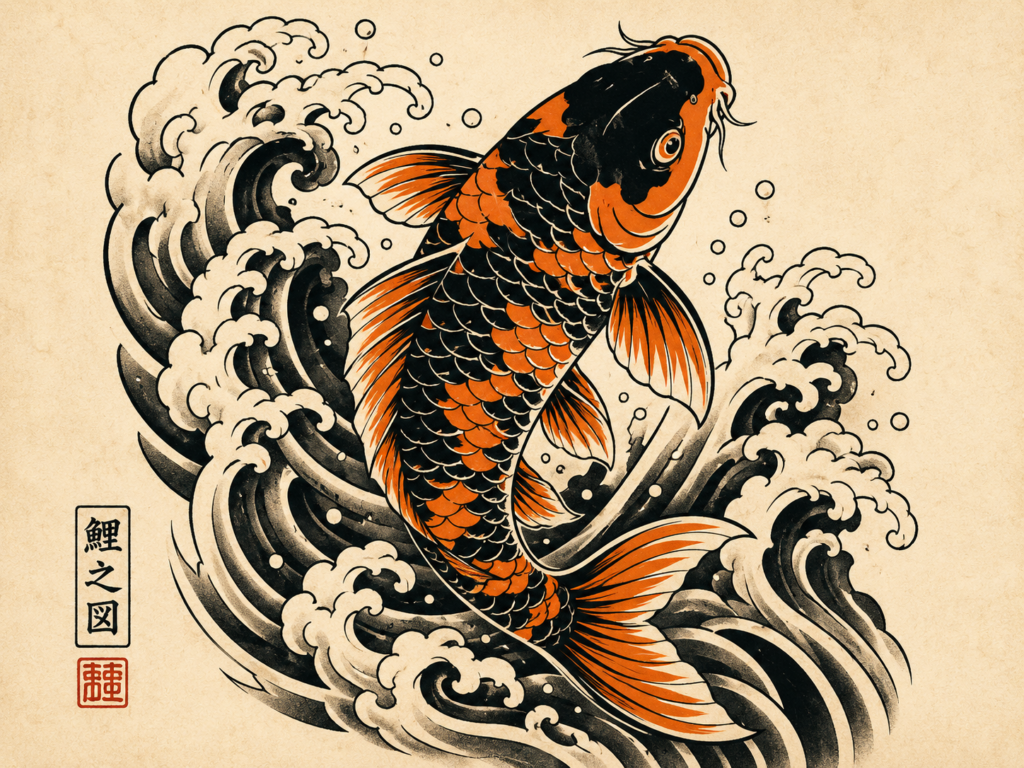
The koi fish is one of the most recognizable images in Japanese tattoo art, and its popularity comes from a well-known legend. According to the story, a school of koi attempted to swim upstream against a powerful waterfall on the Yellow River. Most gave up, but one koi persisted for years, leaping again and again, until the gods rewarded its determination by transforming it into a dragon. From that legend comes the koi’s core meaning: perseverance in the face of adversity, and the belief that struggle, when endured long enough, leads to transformation.
This is why koi tattoos are frequently chosen by people going through — or having overcome — a difficult period in their lives: recovery, career setbacks, personal loss, or any long fight that eventually pays off. The image works as a kind of quiet promise to the wearer that hardship is not permanent.
Details in the design matter as much as the image itself. The direction the koi is swimming is often read symbolically — a koi swimming upstream usually represents someone still in the middle of a struggle, still pushing toward a goal, while a koi swimming downstream is sometimes read as a sign that the fight has already been won. Color adds another layer: a black koi is traditionally linked to overcoming hardship and adversity, a red or orange koi is tied to strength, love, or masculine energy, and a blue koi can represent reproduction or masculinity depending on regional interpretation. Because of this flexibility, no two koi tattoos carry quite the same story, even when the base image looks similar.
The Dragon: Wisdom, Protection, and Power
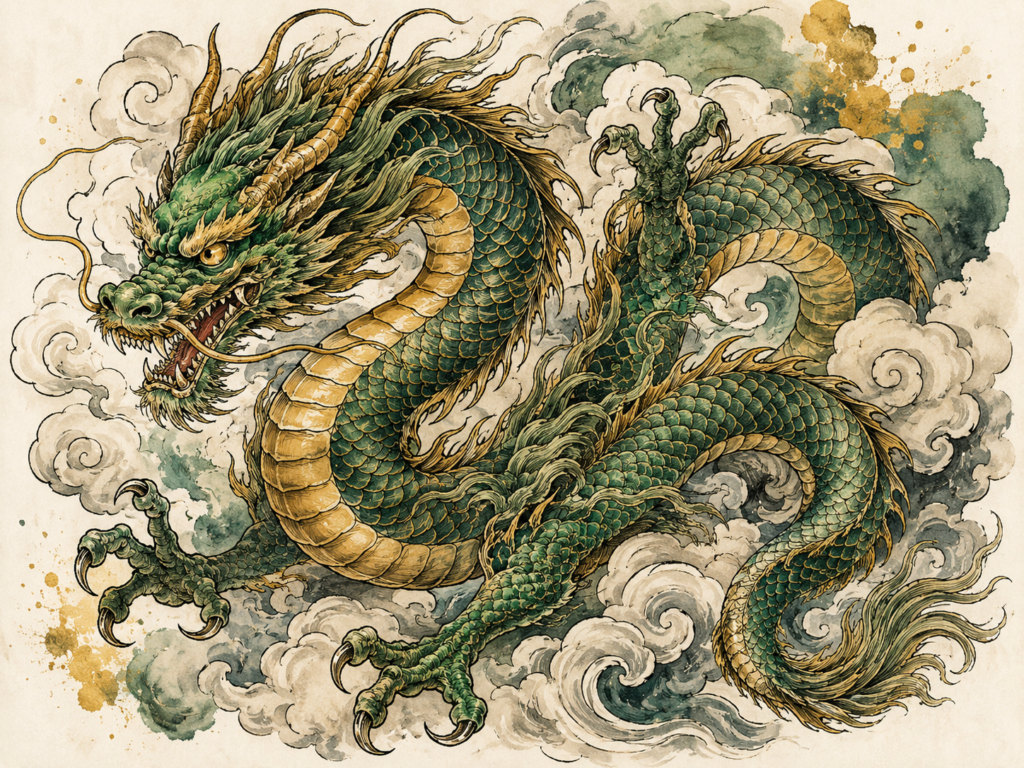
Unlike the fire-breathing, villainous dragons common in Western mythology, the Japanese dragon, or ryu, is generally a benevolent, wise, and protective creature. Dragons in Japanese folklore are closely tied to water, weather, and good fortune — they’re often depicted as guardians of rivers, seas, and rain, rather than hoarders of treasure or destroyers of villages. This distinction matters a great deal to how the image is used in tattoo art: a dragon on the skin is less about menace and more about a powerful, benevolent force watching over the wearer.
In classic tattoo composition, dragons are almost never shown as static, front-facing creatures. They’re drawn coiling and weaving — around an arm, down a back, between clouds, waves, or koi — visually reinforcing the idea of a force that moves fluidly through nature rather than one that simply dominates a scene. This flowing, serpentine form is also a practical advantage for tattoo artists: it adapts naturally to the curves of the body, which is part of why dragons are such a common choice for large-scale work like full back pieces, sleeves, or full-body suits.
People drawn to dragon tattoos are often seeking a theme of strength paired with wisdom — not raw aggression, but power that has been earned and is used to protect rather than to harm. It’s a subtly different message than the Western dragon carries, and it’s one reason the motif has aged so well across generations of tattoo collectors.
Cherry Blossoms: Beauty in Impermanence
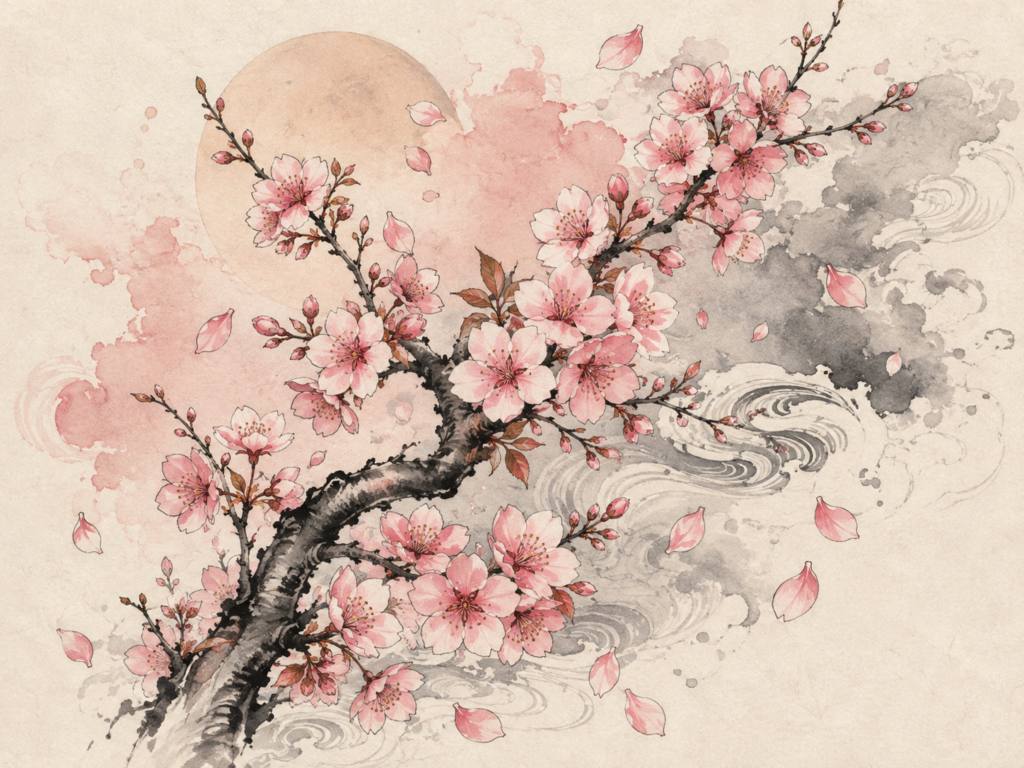
Few images are as tied to Japanese aesthetics, in tattoo art or anywhere else, as the cherry blossom, or sakura. Each spring, cherry trees across Japan bloom in a spectacular, short-lived display — and within roughly one to two weeks, the blossoms fall. This brief, brilliant bloom is the entire point of the symbol. Sakura represent the idea that beauty, youth, and life itself are temporary, and that this impermanence is exactly what makes them worth appreciating in the moment.
This concept has a name in Japanese aesthetics — mono no aware, a gentle, bittersweet awareness of the transience of things — and it runs through centuries of Japanese art, poetry, and philosophy well beyond tattooing. When it shows up on skin, it carries that same weight: a quiet acknowledgment that nothing, including the wearer’s own life, lasts forever, and that this is not something to fear but something to sit with.
In tattoo work, cherry blossoms are rarely used as a standalone image. Far more often, they’re woven into larger compositions — framing a dragon, softening the harder lines of a koi piece, or drifting across negative space around a central figure. Falling petals in particular are a favorite device for tattoo artists, since scattered blossoms can guide the eye across a large piece and fill empty space without competing with the main subject. Even in a composition dominated by a powerful dragon or a fierce koi, a scattering of sakura petals acts as a quiet reminder of time passing.
Why These Symbols Endure
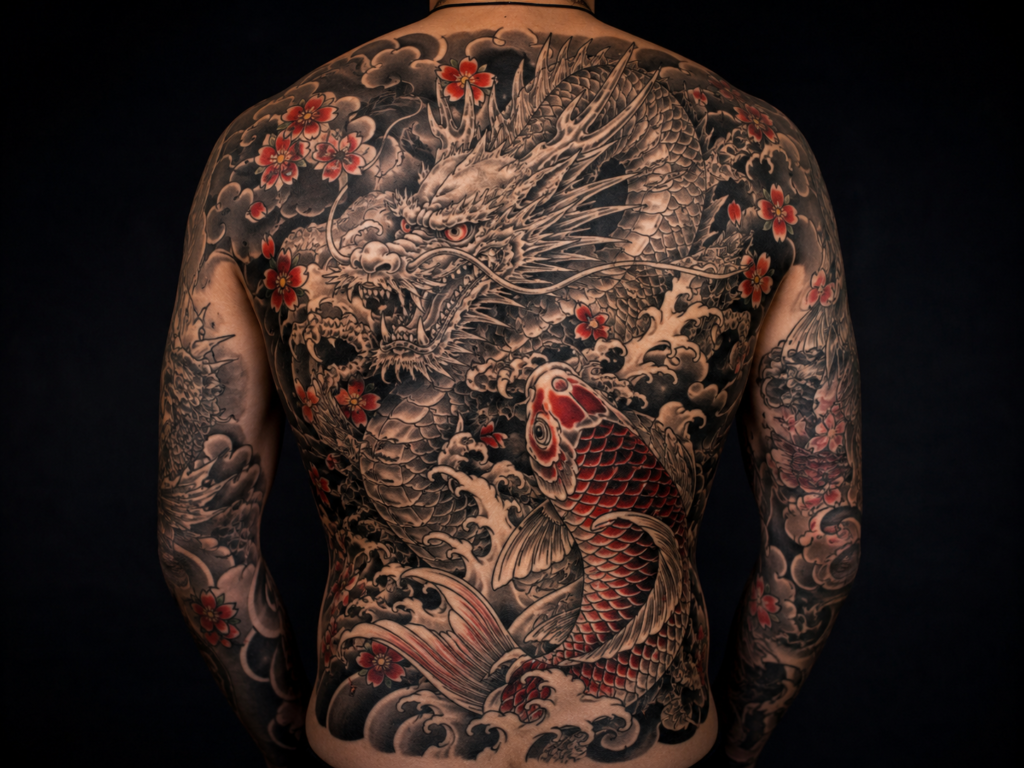
What makes these motifs so enduring — both within Japan and in tattoo studios around the world — is that they were never just decorative images to begin with. They’re part of a symbolic system with roots in folklore, Buddhist and Shinto thought, and centuries of woodblock print and painting tradition. A koi is never just a fish, a dragon is never just a mythical creature, and a cherry blossom is never just a flower; each one is shorthand for an idea that Japanese art and storytelling have been refining for generations.
Even collectors far outside Japan, who may know little about the folklore behind the images, are often drawn to these motifs because the underlying ideas — perseverance, protection, wisdom, the acceptance of life’s transience — are close to universal. That combination of striking visual style and deep, portable meaning is a large part of why Japanese-style tattooing has become one of the most widely practiced and imitated traditions in the world. Understanding the symbolism doesn’t just add trivia to the tattoo; it changes how the whole piece is read — not as a collection of pretty images, but as a visual language, still being spoken today on skin around the world.